
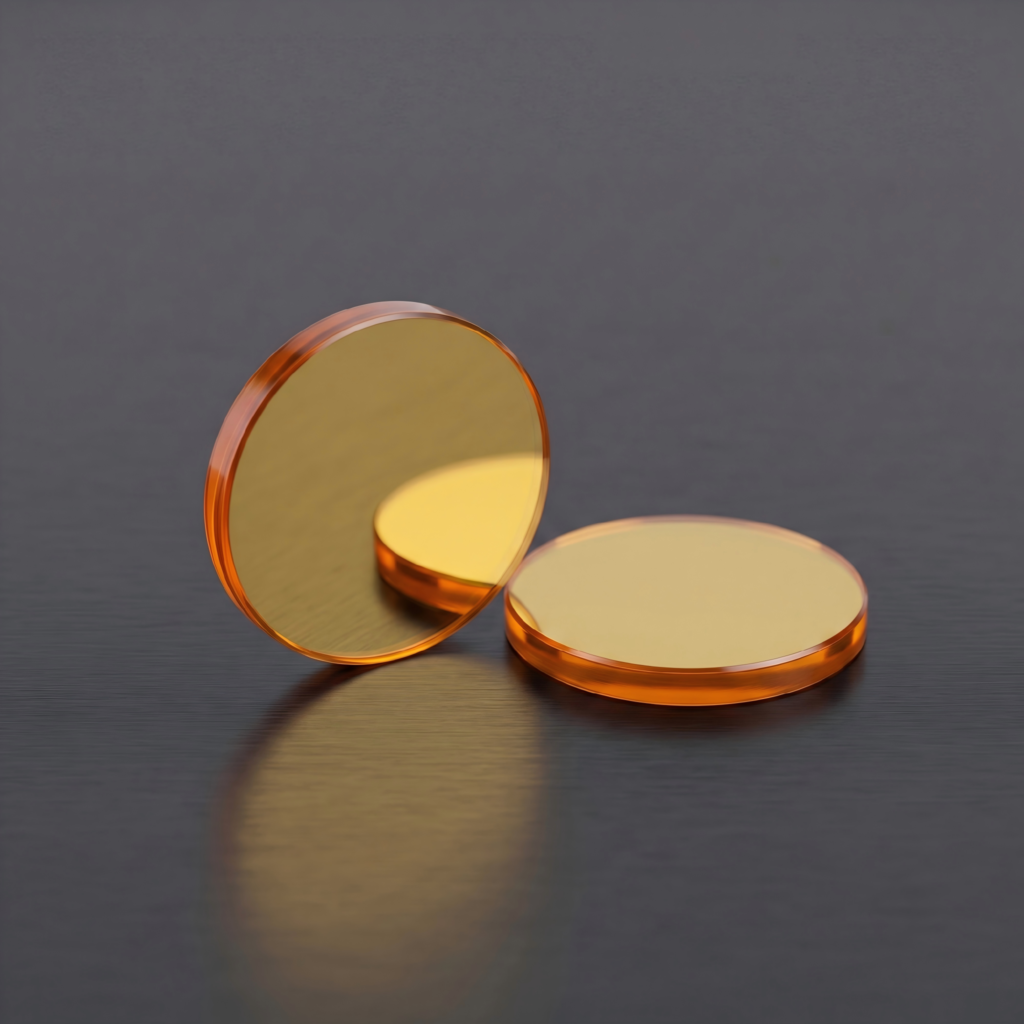
Precision ZnSe Windows (CO2 Laser Protective Optics)
Ultra-Low Absorption | 10.6μm High Transmission | OEM Customization
- Low Absorption: CVD ZnSe helps reduce thermal effects in high-power CO2 laser systems.
- High Transmittance @ 10.6 µm: BBAR coatings available to reduce reflection losses in industrial CO2 laser systems.
- Protective Window: Helps shield internal resonator optics from dust, debris, and process contaminants.
- OEM & Industrial Supply: CVD ZnSe windows are available in custom diameters, thicknesses, and coating specifications for industrial CO2 laser systems.
Send your required diameter, thickness, wavelength, and coating specifications for a technical review and quotation.
Technical Specifications
| Technical Parameter | Specification |
|---|---|
| Substrate | CVD ZnSe |
| Design Wavelength | 10.6 μm (CO2 Laser) |
| Dimensions (Diameter) | Custom (Standard sizes: 12.7mm, 19.05mm, 20mm, 25.4mm, 38.1mm) |
| Dimensional Tolerance | +0.0 / -0.1 mm |
| Thickness Tolerance | ±0.1 mm |
| Surface quality | 40-20 Scratch-Dig (Standard), tighter specifications available on request |
| Surface Flatness | < λ/4 PV @ 632.8 nm (Standard), tighter specifications available on request |
| Parallelism | < 3 arc minutes (Customizable) |
| Standard Coating | BBAR @ 10.6 µm, custom reflectance specifications available |
| Clear Aperture | > 90% of central diameter |
Product Overview
Protective Optics for High-Power CO2 Lasers
ZnSe windows are critical passive components in industrial CO2 laser systems. Positioned at the output port of the laser cavity or as a protective shield within the beam delivery system,they can serve as protective windows in sealed optical assemblies while allowing the 10.6 µm beam to pass with low optical loss when properly coated for the operating wavelength. By isolating the delicate internal optics from harsh manufacturing environments, our ZnSe windows help protect downstream optics from contamination and debris, supporting longer service intervals in industrial CO2 laser systems.
Thermal Stability for Continuous Operations
In high-power metal cutting and deep engraving applications, optical absorption is converted into heat, which can contribute to thermal lensing and reduced beam stability. CVD-grown ZnSe offers high structural homogeneity and low absorption, helping support stable transmission during continuous industrial operation. Proper substrate quality and coating design also help reduce thermal effects and maintain consistent optical performance over extended processing cycles.
OEM Integration & Scalable Supply
Whether you need standard replacement windows for aftermarket maintenance or custom-dimensioned optics for newly developed laser systems, we support both small-batch and OEM production requirements. ZnSe windows can be supplied with custom diameters, thicknesses, edge chamfers, and coating specifications to match your mechanical and optical design. Precision edge finishing helps reduce chipping and micro-fracture risk, while controlled dimensions support consistent installation and long-term integration in industrial CO2 laser assemblies.
Metrology & Performance Reports
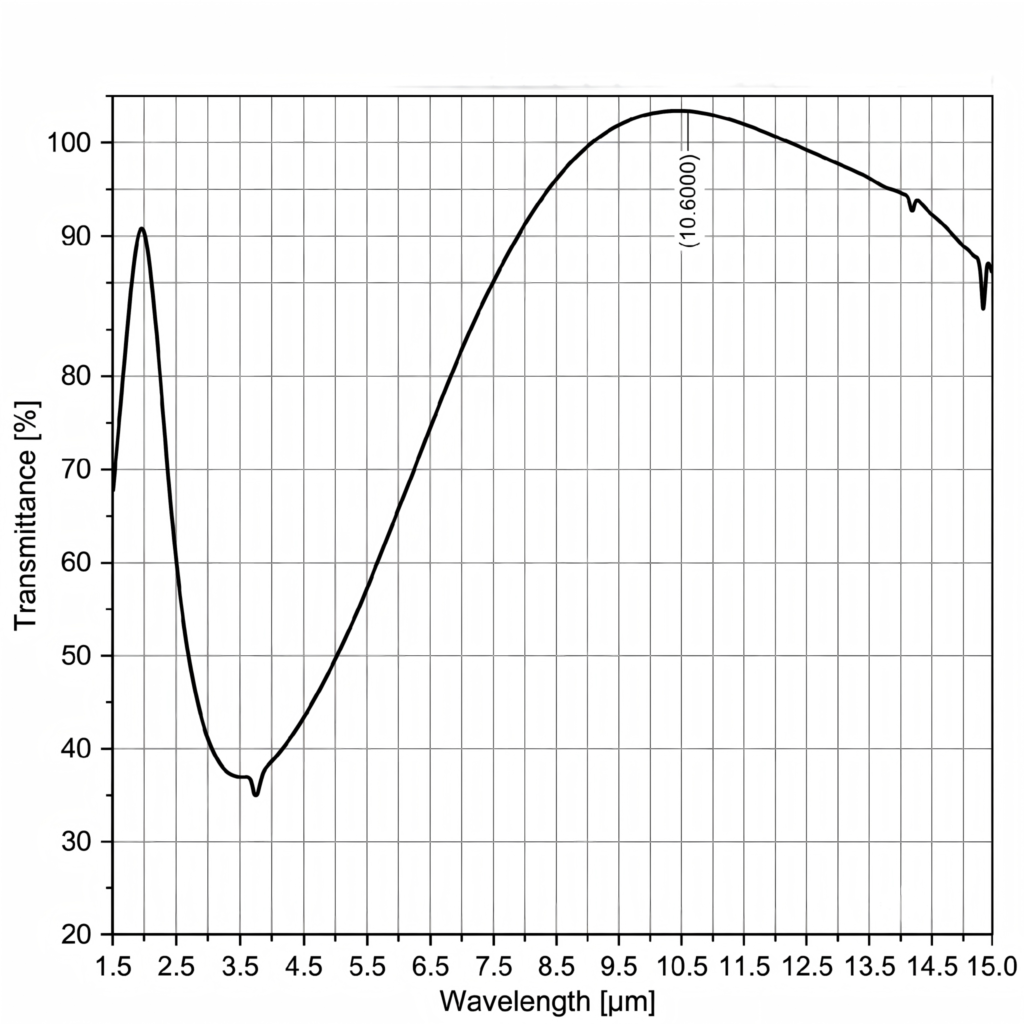
The measured sample shows peak transmittance above 99% near 10.6 µm, demonstrating efficient energy transmission and low optical loss for CO2 laser applications.
Performance Validation & Metrology Analysis
- Testing Equipment: FTIR Spectrophotometer
- Target Wavelength: 10.6μm (Industrial CO2 Laser)
- Performance Index: Measured peak transmittance above 99% near 10.6 µm on the tested sample, with low bulk absorption.
- Optical Edge: Precision broadband anti-reflective (BBAR) coatings help reduce reflection losses per surface and improve laser energy transmission.
- Benefit: Helps reduce thermal lensing and structural degradation under high-power conditions, supporting stable beam delivery for continuous metal cutting and industrial material processing.
Leverage Our In-House Metrology Capabilities
Struggling with power loss, thermal lensing, or frequent window replacements in your high-power laser systems? Clarvis Industrial supports optical performance verification with FTIR spectral analysis, coating evaluation, and other inspection methods based on project requirements. Connect with our engineering team to review fabrication specifications and support suitable optical solutions for continuous industrial operation.