
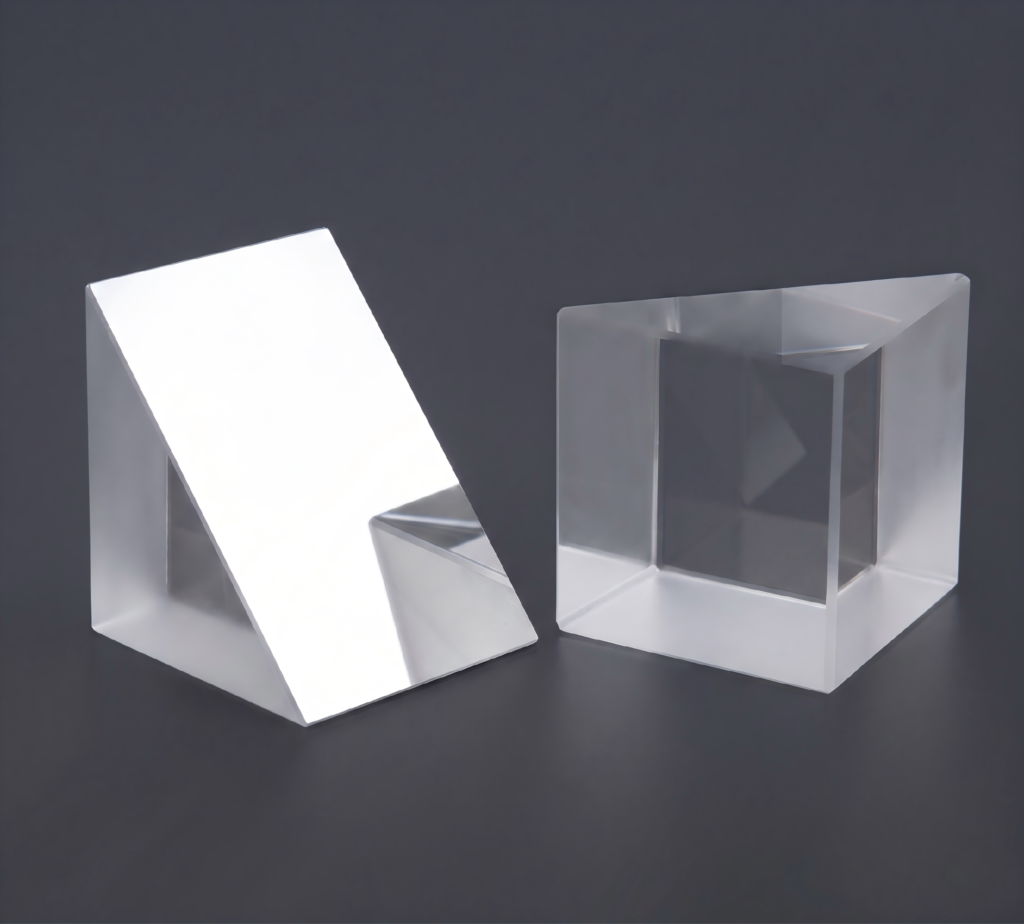
Precision Right Angle Prisms for Optical Deflection
90° Beam Routing | High-Efficiency TIR | Custom OEM Tolerances
- 90° or 180° Beam Deviation: Uses Total Internal Reflection (TIR) to redirect image paths or laser beams through 90°, and can also support 180° beam return configurations when used in appropriate retroreflection geometries.
- Simplified Alignment: The rigid 90° prism geometry provides a stable mechanical reference and can help simplify mounting and alignment in optical assemblies and automated systems.
- High Surface Accuracy: Polished to controlled surface flatness specifications (typically < λ/4 PV), helping reduce wavefront distortion and support high-contrast imaging and metrology applications.
- OEM & Industrial Supply: Right angle prisms are available with custom dimensions, substrate options, surface specifications, and coatings for imaging, laser, machine vision, and metrology applications.
Technical Specifications
| Technical Parameter | Specification |
|---|---|
| Substrate | Premium Optical Glass (K9/N-BK7), UV Fused Silica |
| Dimensions (A=B=C) | Custom (Typical range: 2mm to 100mm) |
| Dimensional Tolerance | ±0.1mm (Standard) / ±0.05mm (Precision) |
| Angle Tolerance (90°) | ±3 arc minutes (Standard) / ±10 arc seconds (Precision) |
| Angle Tolerance (45°) | ±3 arc minutes (Standard) / ±15 arc seconds (Precision) |
| Surface Quality | 40-20 Scratch-Dig (Standard), tighter specifications available on request |
| Surface Flatness | < λ/4 PV @ 632.8nm |
| Clear Aperture | > 90% of central dimension |
| Coating Options | Uncoated (TIR), BBAR on input/output legs, or HR metallic on hypotenuse |
Product Overview
Rugged Alternative to Surface Mirrors
In environments with high mechanical vibration or shock, standard mirrors can easily fall out of alignment or suffer surface degradation. Right angle prisms offer a solid-state, highly durable alternative. Because the reflection happens internally (TIR) or via a protected hypotenuse coating, the critical reflecting surface is shielded from environmental contaminants, dust, and handling damage.
High Optical Throughput
For standard configurations using Total Internal Reflection (TIR), the prism achieves near 100% internal reflectivity without the need for delicate metallic coatings. To further optimize energy throughput for your specific system, we can apply custom Broadband Anti-Reflective (BBAR) coatings to the entrance and exit legs, helping reduce ghost reflections and improve signal transmission to CMOS sensors.
Reliable OEM Supply
We support OEM and industrial customers with custom right angle prisms for imaging, laser, machine vision, and metrology systems. Custom dimensions, substrate options, surface specifications, coatings, and packaging can be provided to support reliable integration and repeat production requirements. Small-batch production, drawing-based manufacturing, and repeat-order support are also available for ongoing OEM projects.
Metrology & Performance Reports
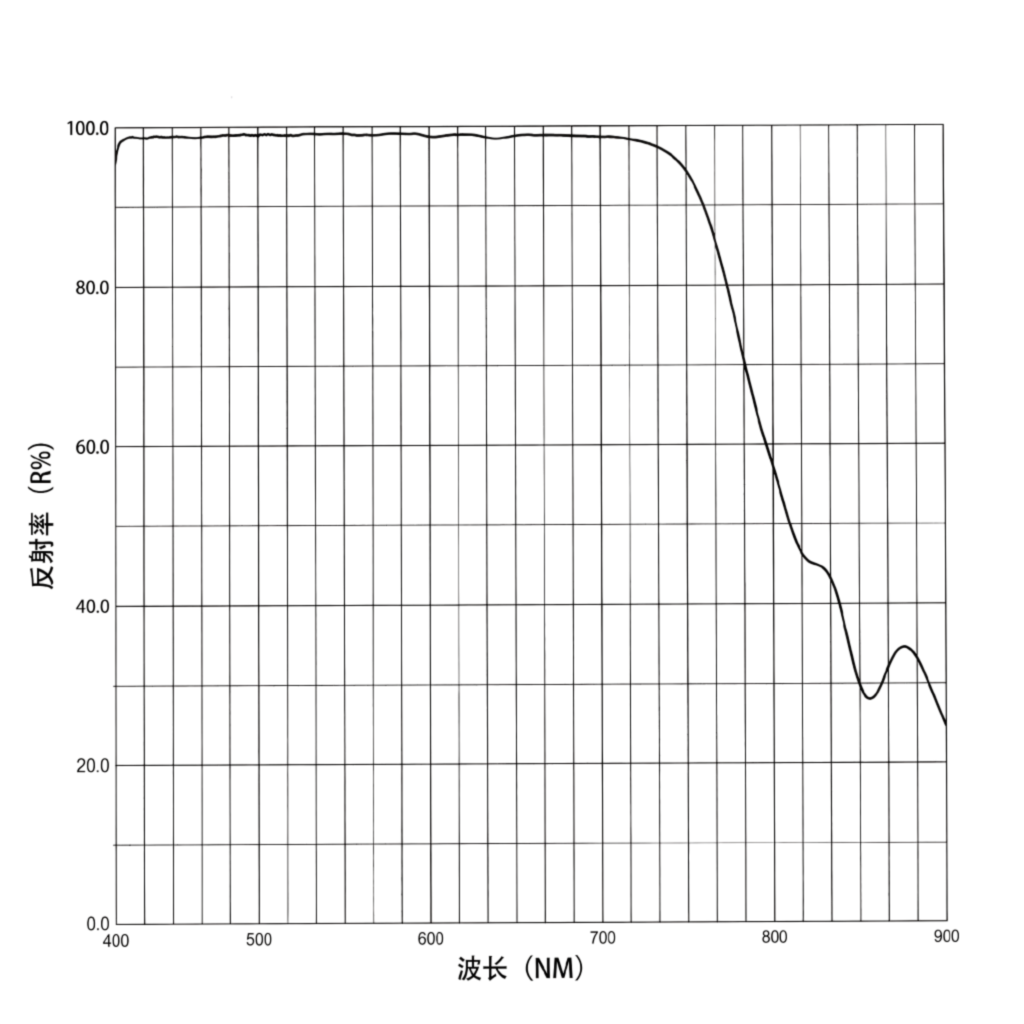
Figure 1: Dielectric HR Coating Reflectance
The measured reflectance remains above 99% across most of the visible range (approximately 400–700 nm), indicating effective high-reflective coating performance for beam redirection applications.
Application & Engineering Integration
- Target Wavelength: Broadband capability across UV, Visible, and NIR spectrums depending on the chosen substrate (UV Fused Silica or K9 glass).
- Performance Index: Tight angular tolerances (down to approximately 10 arc seconds for precision grades) help improve beam positioning accuracy and reduce alignment or image-compensation requirements in precision optical systems.
- Mounting Ready: Edges can be chamfered (e.g., 0.2 mm × 45°) to help reduce the risk of edge chipping during assembly and support integration with custom V-blocks or optomechanical mounts.
- Primary Applications: Commonly used in folded optical systems, compact machine vision assemblies, borescopes, laser alignment tools, and automated dimensional measurement equipment.
Custom Coating & Sub-Assembly Services
If your system requires a coated hypotenuse or custom mounting configuration, our technical team can review your CAD files and help define suitable coating, dimensional, and integration specifications for your optical assembly.