
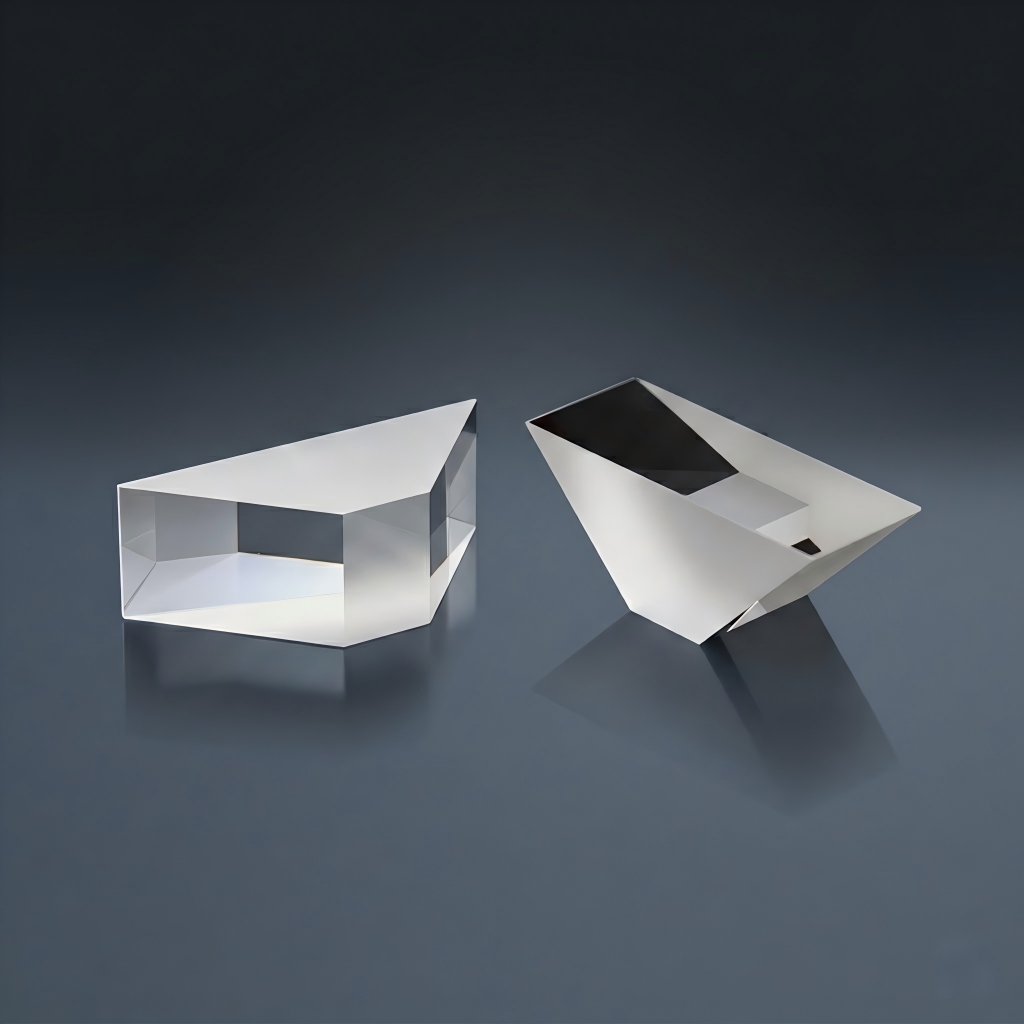
Custom Dove Prisms for Precision Image Rotation
Dynamic Image Control | 180° Inversion | OEM Custom Specifications
- Precision Image Rotation: When the prism is rotated around its longitudinal axis, the transmitted image rotates by approximately twice the prism rotation angle, supporting adjustable image orientation in imaging and optical alignment systems.
- High-Fidelity Optical Path: Manufactured from homogeneous optical glass with controlled surface flatness (typically < λ/4 PV), helping reduce wavefront distortion and support high-resolution imaging applications.
- Optimized Throughput: Available uncoated for Total Internal Reflection (TIR) applications, or with custom Broadband Anti-Reflective (BBAR) coatings on the entrance and exit faces to help reduce reflection losses and improve signal transmission.
- OEM & Industrial Supply: Available for commercial imaging, Automated Optical Inspection (AOI), and industrial instrumentation applications, with custom dimensions, substrates, coatings, and specifications available for OEM projects.
Technical Specifications
| Technical Parameter | Specification |
|---|---|
| Substrate | Optical Glass (K9/N-BK7), UV Fused Silica |
| Dimensions (Length/Aperture) | Custom (Typical length: 10mm to 100mm) |
| Dimensional Tolerance | ±0.1mm (Standard) / ±0.05mm (Precision) |
| Angle Tolerance | ±3 arc minutes (Standard), tighter tolerances available on request |
| Surface Quality | 40-20 Scratch-Dig (Standard), tighter specifications available on request |
| Surface Flatness | < λ/4 PV @ 632.8nm |
| Clear Aperture | > 90% of central dimension |
| Coating Options | Uncoated for TIR configurations, or custom BBAR coatings on entrance and exit faces |
Product Overview
Dynamic Control for Vision Systems
Dove prisms are widely used in optomechanical systems requiring image inversion or controlled rotation. Because the transmitted image is inverted by 180°, they are commonly applied in interferometry, astronomy, and advanced machine vision systems to help adjust image orientation without moving the camera itself. They are also well suited to compact folded optical systems where space is limited.
Controlled Wavefront Quality
Due to the long optical path length within a Dove prism, substrate homogeneity and polishing quality are important for maintaining wavefront performance. We control surface flatness and offer K9/N-BK7 or UV Fused Silica substrates to help reduce astigmatism and wavefront distortion in precision imaging systems. Custom surface specifications and coating options can also be tailored to suit different imaging, alignment, and metrology requirements.
Reliable OEM Supply
We support OEM and industrial customers with custom Dove prisms for imaging, machine vision, metrology, and optical instrumentation. Custom dimensions, substrate options, surface specifications, coatings, and packaging can be provided to match different integration requirements. Small-batch production, drawing-based manufacturing, and repeat-order support are also available for ongoing OEM projects and system-level optical assemblies.
Metrology & Performance Reports
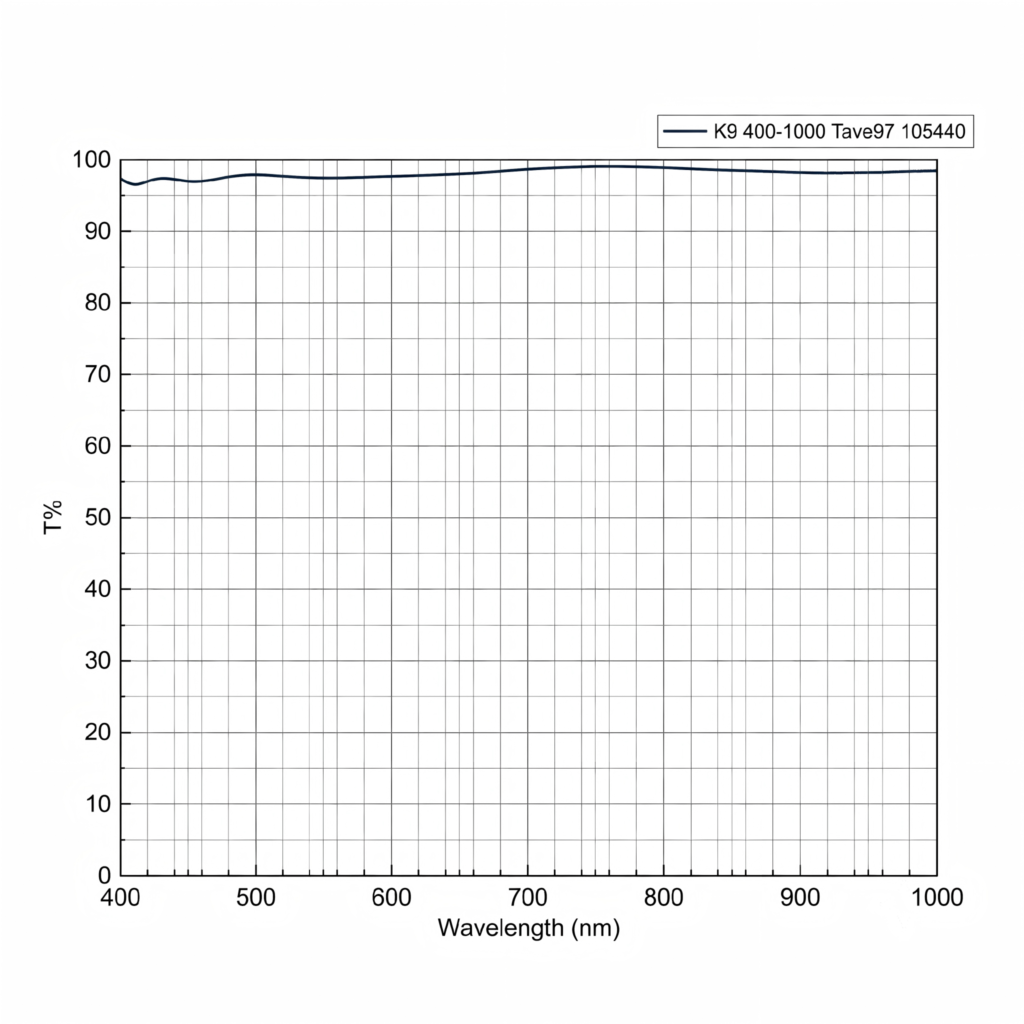
Figure 1: Dove Prism Transmittance
The measured transmittance remains approximately 97% or higher across most of the 400–1000 nm range, demonstrating the combined performance of BBAR-coated entrance and exit faces with Total Internal Reflection (TIR) inside the prism.
Metrology Analysis & Application Fit
- Target Wavelength: Broadband capability across UV, Visible, and NIR spectrums depending on the chosen substrate.
- Operational Note: Dove prisms are generally best suited for collimated light. Converging or diverging beams can introduce additional astigmatism due to the angled entrance and exit faces.
- Primary Applications:
- Image rotators in Automated Optical Inspection (AOI)
- Interferometry and beam profiling
- Periscopes and complex telescope optics
- Polarization control (when customized as a double Dove prism)
Custom Sub-Assembly Services
Mounting a Dove prism can be challenging due to its geometry. We support custom manufacturing with tailored edge chamfers to help reduce the risk of chipping, and can also provide pre-mounted prism assemblies in custom housings for easier integration into rotational stages and optomechanical systems.